Monday, October 22, 2018

It’s a jungle out there: Costa Rica with kids

It's dark in the rainforest, the air thick with strange croaks and chirps, and our group moves slowly, following José's torchlight. As he gestures for us to stop, we gather around in silence, the adults as keen as the children to see what he's spotted. There on a leaf, with its bulging orange eyes, neat green body and comically big tangerine feet, sits a Costa Rican tree frog. Cue delighted squeals all round.

"It's so cute!" whispers my niece, Georgia, and I nod, partly relieved it's not a boa constrictor or tarantula.

We're halfway through a night safari at Maquenque Ecolodge in the far north of the country and the jungle feels tangibly alive. Caiman eyes shine at the edge of the lagoon and frogs and toads of all colours and sizes add to the howler monkeys, turtles and toucans we'd seen earlier in the day.

For somewhere the size of Denmark, Costa Rica packs a powerful punch when it comes to wildlife. A quarter of its land is protected and, with half a million species, it's one of the world's most biodiverse countries.

A wild natural playground with decent tourist infrastructure, it seemed the perfect choice for an adventure to remember with a 12-year-old. It is our first trip together, my first time alone in charge of a child (I don't have kids) and the longest Georgia has been away from her parents. My plan is to show her a world away from life at home – and get her back in one piece.


Thursday, September 27, 2018

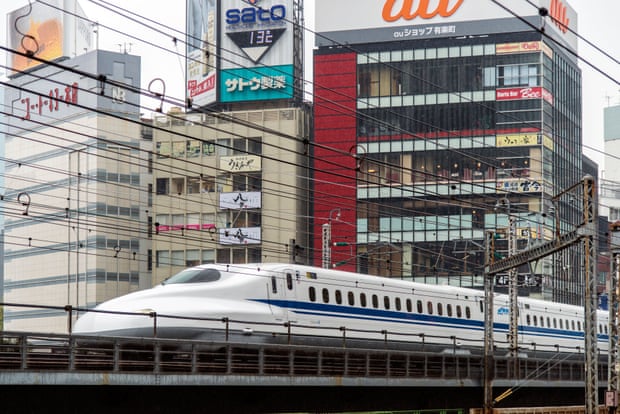
Bite the bullet train and head to Japan

Getting to eat the good stuff in Tokyo can be a challenge. The problem isn't finding the right places. The concierge team at the city's hotels work harder than most making restaurant reservations, and ours at the Mandarin Oriental is no exception. They have sent us to a bustling, wood-lined izakaya, or food pub, down a side street in the city's Akasaka district. Here, smoke pirouettes from the grills in the open kitchens, the beer, like the air conditioning, is beautifully chilled and the tables are crowded with locals.

The problem is that the place is so very local, so very Tokyo, that quite reasonably no one here speaks English, and we speak no Japanese apart from the good manners of "hello" and "thank you". Or so we think. Suddenly our 18-year-old son, Eddie, is sorting the order. He can do numbers and a few other phrases, enough to get an omakase request – roughly, the chef's choice – under way. We are served blocks of silken tofu under umami-rich tangles of dried fish, plump, gossamer-skinned gyoza and tempura-ed fritters of sweetcorn. Thanks in part to Eddie, we do eat the good stuff.

We shouldn't have been surprised. After all, the trip was based on our two teenage boys' engagement with Japanese culture from London. Eddie and his 14-year-old brother, Dan, have long been armpit deep in the stuff. They have watched endless anime, read manga and played the games. They know a good bowl of ramen from the merely mediocre. It should be no surprise that Eddie has picked up some of the language. I suggest to my other half that instead of our usual holiday lazing by a European pool, we should be intrepid and together explore the real Japan before our sons are too old to want anything to do with us. Pat looks at the weather forecast. "You know it's stinking hot in Japan in August," she says.

I nod and say: "But ramen… I have my priorities."

Exploring Japan is not straightforward. In the major cities, many signs and announcements are in English, but an awful lot isn't. The culture is deceptively complex, and a bit of help can save a lot of time and anxiety. We have a tour company called Inside Japan on our side. They have sorted the itinerary, supplying us with pre-loaded cards for the Tokyo metro, along with Japan Rail passes which enable us to take the famed bullet trains from Tokyo to Kyoto, and finally into the forest around Mount Fuji.

They secure us tickets for a sumo match and one morning we rattle out across the seemingly endless low-rise Tokyo suburbs to a local gymnasium, where we are among the very few non-Japanese in a crowd of thousands. Huge, melon-bellied men wrestle each other for mere seconds amid the slap of chest on chest, in between lengthy bouts of ritual and chanting. It's utterly compelling.
Monday, August 13, 2018

Pride of West Virginia seeks donations for travel

 the date of the home opener at Milan Puskar Stadium — hundreds of fans will enter the venue early to see and hear the Mountaineer Marching Band.

But before that kickoff, the Pride members are hoping to travel to North Carolina on Sept. 1 for WVU’s season opener against Tennessee in Charlotte.

The band also hopes to make a trip to Raleigh, N.C., Sept. 15, to help cheer on WVU in its game against North Carolina State.

Alumni and friends of WVU and the Mountaineer Marching Band are being asked to help the band travel to support the football team at those two North Carolina games.

According to a press release from WVU, donations are being accepted to the Pride Travel Fund, established by the WVU Foundation, to help reduce traveling costs for the Pride of West Virginia, as the band has long been known.

Both trips south are expected to include stops in southern West Virginia. Details on those performances are still being put together. The band also will travel to Kingwood for the


"The Pride Travel Fund is an invaluable resource for the WVU Mountaineer Marching Band. The costs involved in transporting, housing and feeding a 350-member organization such as The Pride can be extremely high," Scott Tobias, director of bands, said in the release. "The generosity of our donors makes it possible for The Pride to continue to represent WVU and the entire state of West Virginia throughout the region and nation."

Since its inception in 2007, the Pride Travel Fund helped the band travel to many locations, including football games at Auburn, LSU and Oklahoma, as well as performances such as the 2016 Macy’s Thanksgiving Day Parade in New York City.

"As members of the band, we are extremely grateful for the Pride Travel Fund," she said in the release. "It has allowed us to travel to many states during my time in the band, including Arizona, Florida, New York and Texas. Support from our donors helps us gain memorable experiences all while being able to support our team."

Wednesday, July 18, 2018

Travel literature

Jonathan Raban was largely responsible for changing the nature of travel writing. Back in the 1970s when he began, the genre still viewed the world from under the tilt of a Panama hat. ('I looked at the tops of the columns. Were they Doric or Ionic?') It was considered as ill-bred for a writer to reveal anything about themselves as to have illustrations —'the best travel books never do'.

Raban tore a lot of this up, and with glee. He had worked closely with confessional poets from America like Robert Lowell and John Berryman, producing what is still one of the best essays on Lowell's late poems about his messy divorce. He had even been Lowell's lodger for a while. Now he took the same transatlantic approach to travel writing, and elicited the same chorus of disapproval the poets had experienced for being so personal. Yet it was patently as absurd for a writer not to tell the reader if he was going through some emotional turmoil as it would be for a traveller not to tell a companion on that same journey. Even if they were English.

He also took as his subject matter not the Mediterranean or the Middle East, the traditional stomping ground for the men in linen suits, but the brash new world. He returned to America again and again with something of the questioning obsession that Naipaul brought to his books on India.

The best of all his American books is perhaps Hunting Mister Heartbreak, which takes its title from a poem by John Berryman. At the start of the book he announces that there is a sentence which always stirs the imagination of Europe and which promises to deliver the unexpected:'Having arrived in Liverpool, I took ship for the New World.' Raban unpicks the appeal of these lines. It is not just that they are'so jaunty, so unreasonably larger than life'. It is that what turned the Atlantic passage into the great European adventure was not so much the nature of the country that awaited the immigrants as the character of the ocean,'a space too big for you to be able to imagine yourself across'.