Friday, March 20, 2020

Human Hunting Drove The Great Auk Extinct

Analysis of ancient DNA from the North Atlantic penguin driven extinct during the 19th century reveals that even abundant and widespread species can be vulnerable to intense localized exploitation

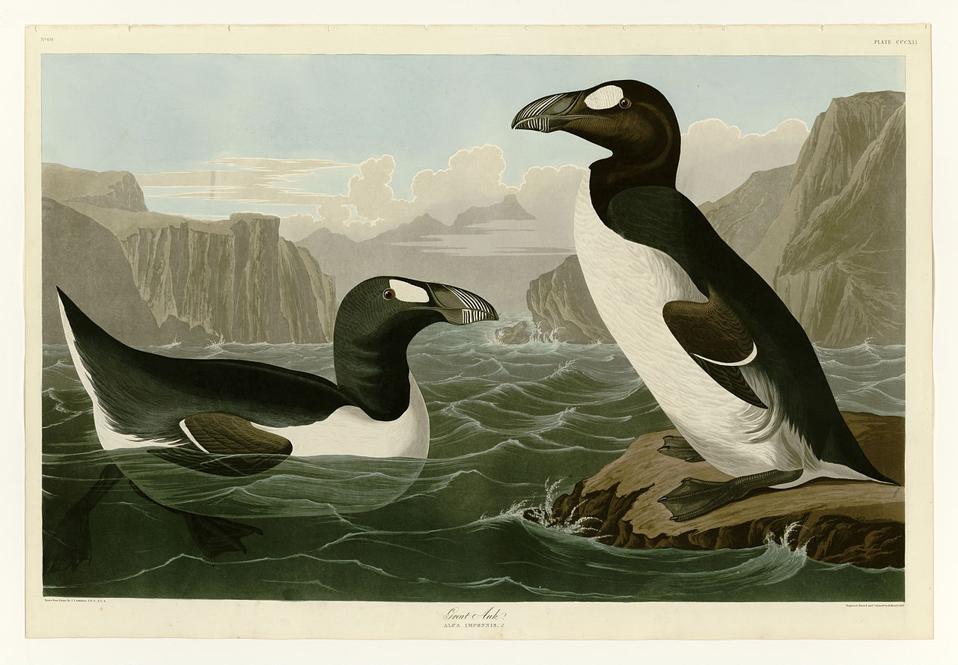
The great auk, Pinguinus impennis, was the original penguin. Millions of these large black-and-white seabirds once ranged widely across the north Atlantic Ocean from the coasts of the northeastern United States and Canada, to Greenland and Iceland, all the way to Norway, Great Britain, France, and the Iberian Peninsula (Figure 1; red area). But by 1844, these birds had all vanished. Why?

The great auk was the largest member of the alcid family that lived in modern times. The Alcidae include familiar seabirds such as razorbills, who are the closest relatives to great auks, as well as guillemots, murres and puffins. But unlike the rest of its relatives, the great auk was flightless — unique amongst birds living in the north Atlantic — and awkward on land, but they were skilled diving birds that used their wings to “fly” underwater in pursuit of fishes and to escape predators.

Then prehistoric humans appeared and began hunting great auks for their flesh and eggs. By 1500, European seafarers joined the melee after discovering the rich fishing areas around Newfoundland — and discovering that great auks were breeding in huge colonies on Funk Island. Having decimated eider ducks by the 1700s, hunters’ attention quickly fixated on great auks, whose feathers became highly prized for pillows and quilts, thereby increasing the frenzied slaughter.

It didn’t take long to obliterate the great auk population. By 1800, humans’ insatiable greed for their flesh, eggs and feathers had reduced millions of great auks to just a tiny group of birds breeding on one island just off the south-west coast of Iceland. But even there, the birds were not safe: although they were no longer profitable to hunt for food, their skins and eggs were in high demand by collectors and museums. By 1844, the last two great auks were hunted down and strangled by three fishermen on Eldey Island, near Iceland. The birds’ internal organs were eventually placed in a museum. Their single egg, crushed in the hunt, was discarded. Their skins — which could fetch an entire year’s wages — were lost.

Considering the speed of this extinction event, it’s worth asking whether other factors played a role in hastening it: Were great auks already headed for extinction before intensive hunting began? Or was rampant human profiteering and destruction sufficient to drive the species extinct across its vast range?

“Despite the well-documented history of exploitation since the 16th century, it is unclear whether hunting alone could have been responsible for the species’ extinction, or whether the birds were already in decline due to natural environmental changes”, lead author Jessica Thomas said in a press release. Now a postdoctoral researcher at Swansea University, Dr Thomas completed this study as part of her PhD research at Bangor University and at the University of Copenhagen.
Tuesday, January 21, 2020

Fashion Is The Next Battleground For Payment Companies

The payments industry is the center of a multi-billion dollar war. Over the last 18 months more capital than ever before flowed into the space with massive funding rounds and large acquisitions. In May 2018 PayPal acquired iZettle, a mobile payments company offering small businesses with portable point-of-sale solutions, for $2.2 billion, attempting to strengthen its business solutions. In August 2019 Klarna, a payment provider with credit card-alternative payment methods, raised $460 million at a post-money valuation of $5.5 billion. And then there is Stripe, offering a wide range of payment tools for internet businesses, announcing a new financing round this September, bringing its valuation to $35 billion.

In this highly-competitive space, it's not enough for payment companies to be just that–a payment provider, a payment gateway, a facilitator of payments. The only way forward is in reinventing themselves, expanding their offerings and adding extra value to merchants and consumers. For payment companies this transformation is not optional, it's a matter of survival in the long term.

The future of payments is about knowing implicit and explicit wants and needs of consumers and merchants, and the next battleground is fashion.

Sunday, December 29, 2019

How Data Helps Fight Fashion Waste

Geeks and fashion don't usually mix. Software engineers and other technology professionals are known for their reliance on t-shirts, sandals (often worn with socks) or sneakers and a predilection for wearing shorts in the freezing rain and snow. A bold fashion statement for most software engineers is making the decision to dye their hair green or blue.

But putting techie stereotypes aside for a moment, a new intersection point between the tech community and the fashion industry cognoscenti could be surfacing. The fashion industry is notoriously bad at product waste… and technology wants to come to the rescue.

Just hanging around

The BBC has reported one recent example where a fashion designer has helped to develop recyclable clothes hangers. Data analytics applied across fashion industry supply chains has shown the scale of waste in the business; designer Roland Mouret suggests that single-use clothes hangers are the ‘plastic straw' of the fashion industry.   Abendkleider Lang

Working with scientists, Mouret and his team have developed a new hanger constructed from 80% recycled ‘recovered sea plastic' and 20% recyclable plastic. The hanger problem is not just down to customers discarding them after purchase; apparently some fashion companies ship clothes on cheap hangers (which are then thrown away) before they transfer products to ‘fancier' hangers in store.

Hanger recycling company First Mile says that hangers take 1,000 years to break down in landfill. Clearly we need smarter supply chains, smarter city distribution networks, smarter adoption of recycled products and smarter hangers if we are going to combat this waste.

Sunday, November 24, 2019

The 20 Most Anticipated Hotel Openings Of 2020

We all make New Year’s resolutions. The luxury hotel industry is no different. But rather than center its goals around diet changes or finding love, the sector has seemingly joined forces to accomplish one thing in 2020—to show you, the well-traveled guest, that when it comes to having memorable overnight experiences, the best is yet to come.

Whether you’re seeking staggering structures in the heart of a big city or intimate wine country escapes, the coming year will spawn an impressive roster of real estate. Of course, with all the tidying up you’ve resolved to do in your life, you don’t have the time to look into every resort on the cusp of opening its doors. Luckily, Forbes Travel Guide’s editors have donned the hard hats, looked over the renderings and constructed this list of 20 hot spots you’ll be hearing the most about in 2020.

Capella Bangkok

A brand that has sprinkled polished, memorable experiences across Asia and Europe since 2002, Capella is extending its reach to Bangkok in early 2020 with a 101-suite-and-villa beauty that will feature four stylish dining options, an Auriga Wellness spa and countless magical views over the Chao Phraya River.

Four Seasons Hotel Bangkok At Chao Phraya River

Situated on the same riverbanks as Capella Bangkok (and having the same owner), this 299-room wonder is generating its own wave of excitement prior to its early-2020 unveiling. One look at the stunning indoor-outdoor public spaces, seven dining and drinking outlets and riverfront infinity pool, and you begin to see why.
Six Senses New York

It takes a lot to turn heads in Manhattan. Needless to say, with its twisting tower design, contemporary stylings and enviable location between the High Line and Hudson River, the first Six Senses in North America will have little trouble getting attention when it opens in 2020. 
prom dresses canada